by Rachel | Resources & Tips
I’m currently participating in the #MusicTherapyBlogger challenge, hosted by Julie Palmieri at Serenade Designs. This week’s blogging prompt is to write about something that works in our everyday lives as a music therapist, and I didn’t have to think twice about that.
At 38 weeks pregnant, it’s no surprise that I have a GIANT belly. It has been posing quite a challenge for the last couple months or so, but only in these last few weeks has my baby bump made it nearly impossible to effectively play my guitar.
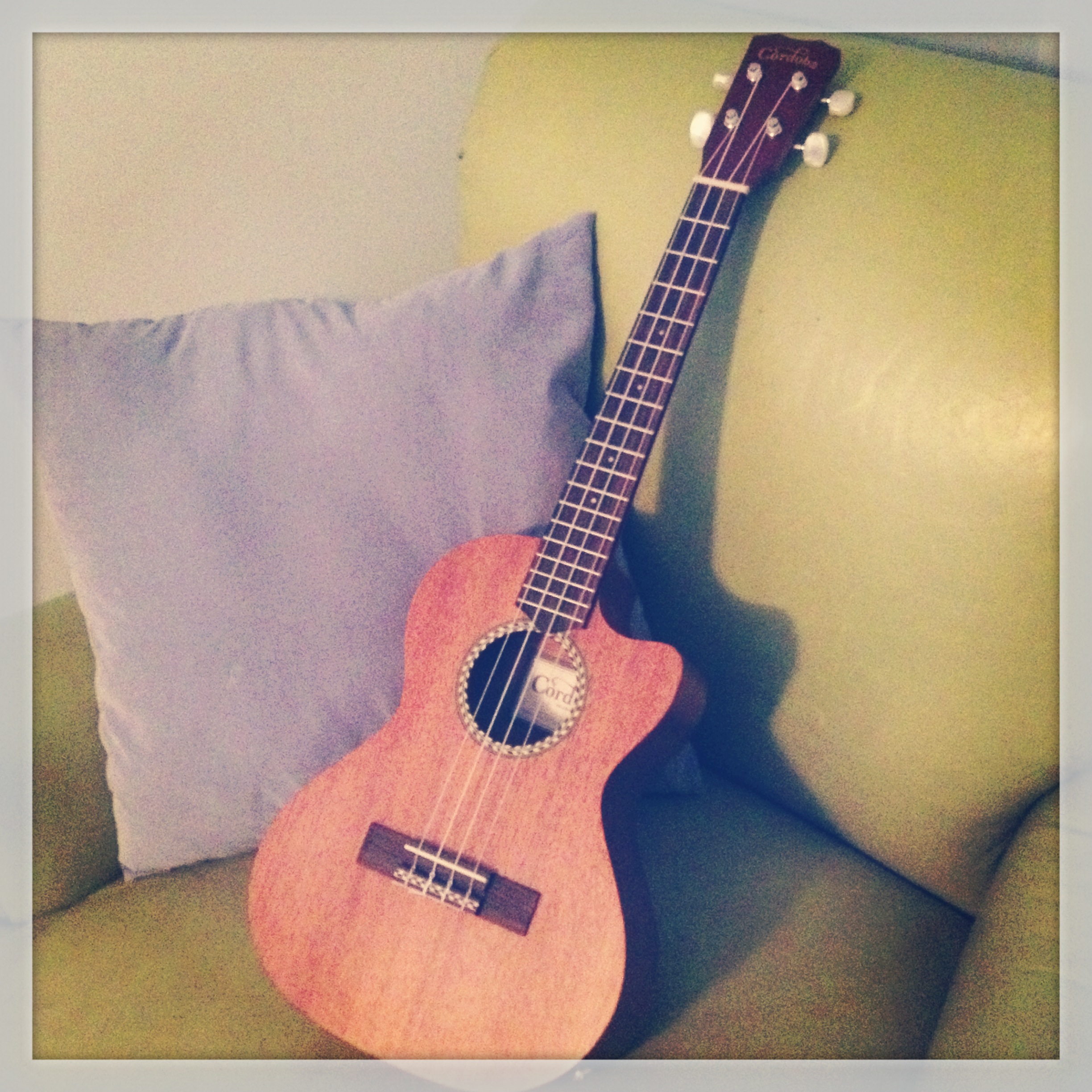
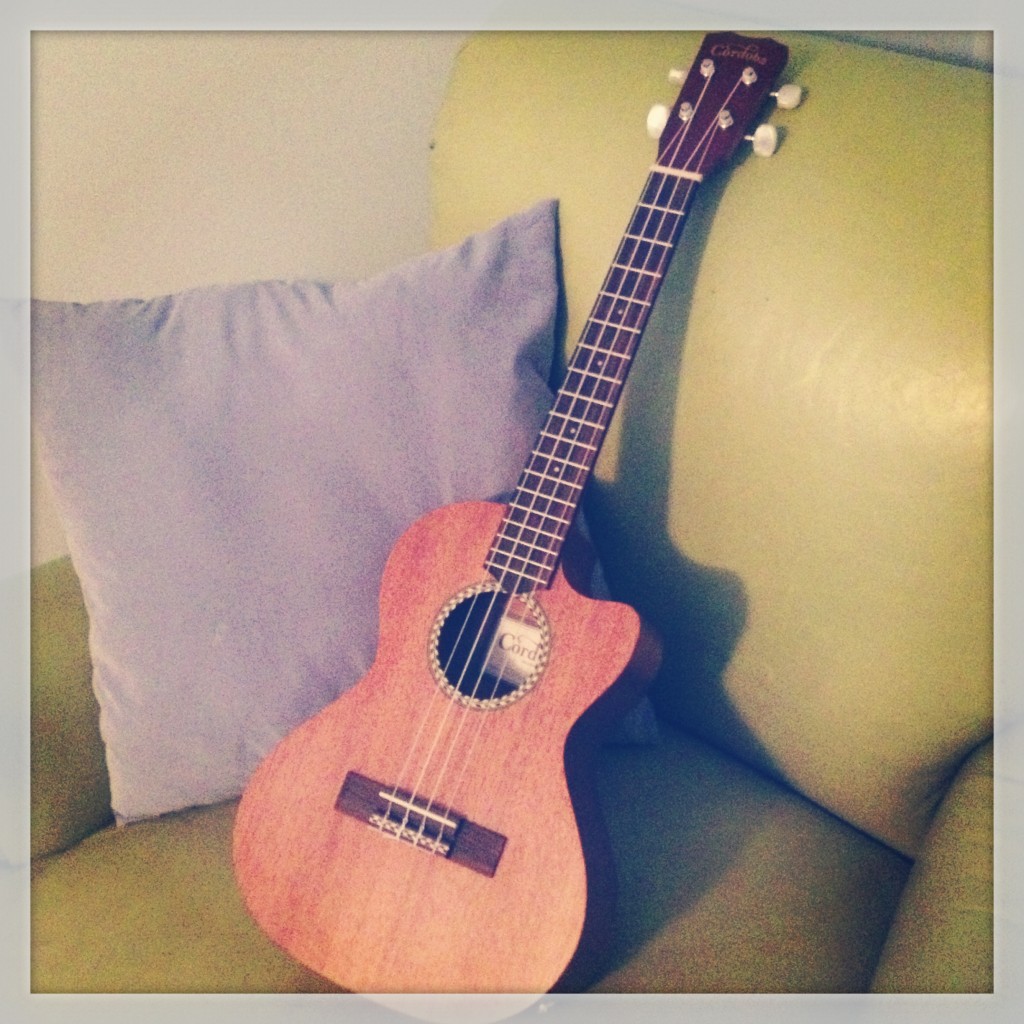
Enter my lovely little Cordoba acoustic-electric tenor ukulele. I got it as a Christmas gift from my parents a few years ago, and it has been a staple in my music therapy sessions, early childhood classes, and gigging adventures ever since. I also find myself picking it up more often than my guitar when I record my songs, which you might have noticed over the last couple years. I love how easy it is to play, the sweet sound it makes, and now more than ever, it’s compact size.
While I have to wear and play my guitar almost completely on my side (making it really interesting to form chords and strum), My ukulele sits on a nice little shelf, aka my belly, and is so light-weight that I can play for a long stretch without it being uncomfortable. I do use a neck strap to keep it from slipping down.
Ukuleles have become pretty trendy in the music therapy world over the last few years, and I had no problem following that trend. Little did I know just how handy it would become late in my pregnancies.
by Rachel | Guitars & Granola Bars
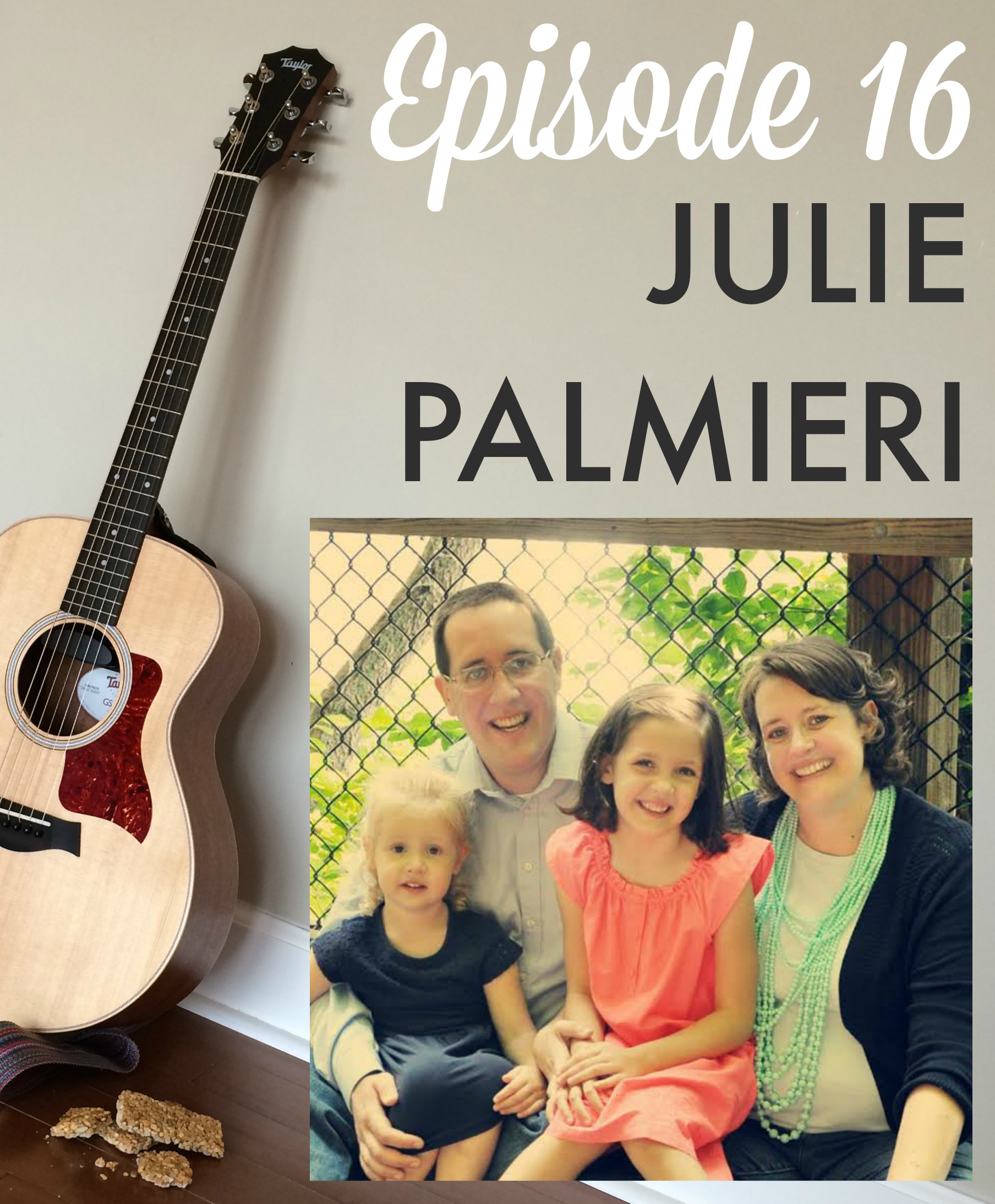
Julie Palmieri is a people person. Of course, this is one of the characteristics that makes her a great music therapist, but her people skills when it comes to online interaction make her especially good at the specialized work she does.
Julie specializes in helping fellow music therapists build, grow and rock their online presence, which allows her to work from home and spend time with her young daughters. I was so excited to interview her about her unique career within the field of music therapy for this week’s podcast episode.
Julie talks about her experiences having two children, leaving the clinical realm to work with music therapists online, and how she is able to raise her girls while working from home in Episode 16 of the Guitars & Granola Bars podcast.
Be sure to check out the show notes page for more information about Julie, along with links to the resources she mentions in the episode.
This episode is sponsored by Music Teacher’s Helper, the best way to manage your private music lesson studio and/or music therapy practice. I’ve used Music Teacher’s Helper every single day since 2011, and it is one of the best tools I have to keep my private practice running smoothly.
Sign up here for a 30-day no risk trial. If you choose to sign up after the trial using my link, you’ll save 20% off your first month!
 Click here to subscribe on iTunes, or search “Guitars & Granola Bars” in the podcast app on your Apple device.

Click here to listen and subscribe on Stitcher, or download and search the app on your mobile device.
by Rachel | Personal Development

This is how I spent a good portion of last weekend: in a hospital gown, with my giant 36.5-week pregnant belly strapped to monitors. It wasn’t pretty, friends.
That’s what happens when self-care goes out the window. You find yourself in the hospital due to severe dehydration, mystery fevers, and painful contractions.
I’m extremely grateful and relieved to tell you that both the baby and I are just fine now; she was never in danger, although her heart rate was elevated due to my state for much of that hospital stay. She’s still inside my giant belly, happily growing and hopefully waiting at least another week or two before making her grand entrance into the world.
I’ve spent much of the past 9 months not feeling well — in the beginning, of course, it was just good old fashioned 1st trimester morning sickness. But these past several months have been rough, too. I’ve had cold after cold with a couple sinus infections and other maladies thrown in, all topped off by the events of this past weekend.
I’ve also pushed myself harder than I probably should have over these past 9 months. The beginning of my pregnancy coincided with the complete restructuring of my business and moving my private practice outside of my house, both of which came with big challenges.
Right in the middle of my pregnancy, we packed up our entire house, sold it, and moved into our dream house just a few blocks away.
And now, just a few weeks from my due date, I’m in the middle of even more (super exciting) business changes, running a Songwriting Challenge, producing a weekly podcast, and marketing my new songbook. These are all positive things, but stressful none the less.
Oh, and did I mention that I have a toddler under the age of 2? :)
So really, there’s no question as to how I ended up in the hospital. As careful as I’ve tried to be throughout this pregnancy, it hasn’t been enough. Self-care is a practice that will remain at the forefront from here on out, even if that just means stepping away from my work more often, going to bed earlier, and getting as much physical rest as I can.
What are some ways you take care of yourself? Ideas are welcome as I enter the final countdown.
by Rachel | Resources & Tips

Songwriting has always been a big part of my work as a music therapist, because I like to use mainly original compositions in my sessions, groups, and classes. Not a week goes by that I’m not coming up with a new song here and there.
Between just having released a brand-new songbook, hosting a Songwriting Challenge for music therapists, and my clinical work as usual, my professional life has seemed to revolve around songwriting for the last month or so — and I’m okay with that!
One of the questions I’m frequently asked by other music therapists is in regards to my songwriting process. I totally get it, because I love hearing about how others do it, myself. Since this pops up so often in my inbox and in conversations with people who want to become more practiced songwriters, I’ll share how my process looks.
Songwriting is a Ritual
Of course, there are plenty of times when I write a song on the fly during a session (which may or may not make it into my memory bank or get written down/recorded later); but in most cases, songwriting for me has become very ritualistic.
I have a particular set-up that must be in place before I begin: my computer in front of me, my guitar to my right, and my iPhone next to me (in the photo above, I substituted my iPad since I was using my phone to take the picture).
While most of my songwriting takes place at my desk in my office, sometimes I change up the location to either my kitchen island (as you see in the photo) or desk at work.
Before I actually start writing, I make sure my guitar is tuned, that I have all the information I need — like correspondence from a client’s parent/teacher/therapist, any facts I’ll use in my song content, my own notes, etc. — in front of me, and then I’m ready to dive in.
Getting It Down on “Paper”
I’m a digital girl all the way, and since I’ll be accessing my song on my iPad during a session (if it’s not completely memorized) or pulling it up on my computer to record later, the actual writing happens on a template I have created in Pages (the word-processing software for Mac).
I always start with the lyrics, since I want to make sure I’m including all the language needed to address a goal or objective for a client or group. I always have RhymeZone pulled up in my browser for help coming up with rhyming words as I write.
My iPhone comes in handy during the lyrics phase, because I record any melody fragments that manifest using the Voice Memos app. This is an important step, because otherwise I will have completely forget them by the time I’m ready to compose the entire melody and figure out chords.
Once the lyrics are complete, I grab my guitar and start piecing together that melody, often referring back to anything I’ve recorded. This becomes a balancing act, singing and strumming and then keeping my guitar from falling off my lap while typing the chords on my lead sheet. I make sure to check and double-check each line for accuracy after the chords are written.
My finished lead sheet is saved in a Dropbox folder as a PDF, along with all of my other original compositions. That way I can easily pull them up on my iPhone or iPad if needed. I save the original Pages document in a folder on my computer, categorized by song topic or purpose.
Learning My Song
My work is not done yet. Once I’ve finished the lyrics, melody, and chords, it’s time to get familiar with the song as a whole since the writing process is often so choppy. I sing and play through the song several times…as many as needed until I’m completely comfortable with the melody and have established the strum pattern I want to use.
Then I go back to my Voice Memos app and delete any of the fragments I recorded earlier. It’s time to create a draft recording — this is what I’ll use as a reference point when it comes time to record the song “for real”.
The Time Factor
Because I have established such a step-by-step process for writing songs, it really isn’t as time-consuming as you might think. It seems as though the time factor is what holds many music therapists back from writing more of their own songs, which is why I always encourage them to establish a process for themselves.
On average, I would say that it takes me about 45-6o minutes to complete the entire process of writing one song. And at the end of that process, not only do I have the song written, but I also have a completed lead sheet and a quick recording.
Establishing YOUR Process
There are so many ways to write songs, and there are no right or wrong ways of doing so. What works beautifully for me may not appeal to you in the slightest.
What does your songwriting process look like? If it’s all over the place, that’s okay too…it’s all about figuring out what works best with your songwriting style and taking into account your preferred methods for creative processes.
Music therapists, I hope you’ll consider taking the Songwriting Challenge! Click below to learn what it’s all about — and then join me to become a better songwriter while earning CMTE credit.

by Rachel | Listen & Learn Music
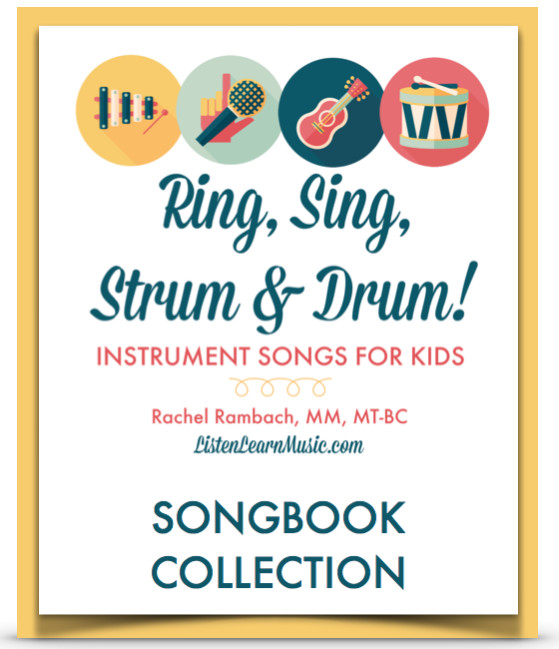
I am so happy to announce that as of today, my new songbook collection — Ring, Sing, Strum & Drum! — is available in its entirety. I have been working SO hard over the last couple of months writing and recording 12 brand-new songs that I think you will love and be able to use with your children, students, and/or clients.
Ring, Sing, Strum & Drum! is a digitally downloaded songbook collection containing 12 never-before released Listen & Learn songs for playing instruments — including rhythm sticks, hand bells, cabasa, castanets, kazoos and more. Not only does the PDF songbook provide the notated melody line, chords and lyrics, but you also receive full and instrumental mp3s for all 12 songs:
“Sh-Sh-Sh-Shake”
“Rhythm Sticks Mix”
“Ring Around the Rainbow”
“Hum a Tune”
“Gather ‘Round the Drum”
“Strum With Your Fingers & Thumb”
“Click Like This, Clack Like That”
“Cabasa Bossa Nova”
“Jingle Jamboree”
“Rainstick Round”
“Lollipop Start & Stop”
“Tam Tam Boo”
Purchasing the lead sheet and mp3s for each individual song would cost you $3 a pop; multiply that by 12 songs and you’re out $36. But since I’m all about sharing the love, I’ve priced Ring, Sing, Strum & Drum! at a mere $12.
With just under a month remaining in the school year, it’s right about this time that your repertoire needs a boost — if you’re anything like me, that is. Whether you work as a music therapist in the classroom or one-on-one setting or you are a music educator, my newest creation might be just the boost you need.
(And for even more instrument songs for children, you should take a look at my best-selling songbook collection, Tapping, Shaking, Music Making!)