The Ins & Outs of Running a Studio

Running a Private Practice or Studio

Earlier this week, I received an email from a reader with a few questions regarding the business and practical aspects of running a music therapy and teaching studio.

Thank you for all you do for music therapy advocacy and encouraging music therapists with ideas. Your energy and ideas inspire me to be more creative in my own practice. I’ve been following your blog for about 6 months now and love it, especially for the practical ideas it gives me for interventions. I’m a music therapy contractor working with hospice patients and preschool children at this time. I have only contracted with facilities until now, at which point I have an opportunity to possibly be the music therapist at a new “alternative” music academy. My understanding is that it is geared toward adaptive music lessons for kids with special needs, and they also want music therapy to be offered.

She then proceeded to list her questions, which I answered at length via email.  After all that typing, I decided that since I get these kind of questions so often, I’d just share my answers here on the blog.  So here they are!

Should I bill each student and have them pay for the upcoming month at the beginning of the month, to reduce chronic late payers?

Honestly, I prefer weekly billing. My students’ parents know that I expect payment every week at the lesson or session, and if for some reason they forget, they just double up the following week or mail me a check. However, I’ve been using (and 100% recommend) the online studio management software Music Teacher’s Helper and this makes monthly billing a snap.  You should also take into account whether or not you have time for make-up lessons and sessions; at this time, I do not, which is why I lean toward weekly billing.

What should the consequences be if a payment is late?

I currently do not have a late payment penalty in place. Maybe I’m lucky compared to most, but I almost never have to deal with late payments. I think this has to do with the fact that my students pay weekly. If you do choose to bill monthly and want to have a late payment penalty in place, you could decide on a flat fee or maybe charge the cost of a lesson.

What should the expectations be for behavior in the studio?

I make my expectations very clear in the form of a letter to families when they join my studio. I outline my policy for parking, entering (don’t knock or ring the doorbell, take your shoes off), and waiting (use the living room, you may watch tv, where the restroom is located), as well as how I expect students to behave in their lessons or sessions.

The #1 expectation is respect — not only of me, but of my instruments, equipment, and the studio as a whole. It’s important to establish this early on, and to enforce it regularly. I’m laid-back in many ways as a teacher and therapist, but not when it comes to the treatment of my materials and myself. I also have a NO WHINING/I CAN’T policy that is repeated far more frequently than I’d like :)

What forms should a parent/student sign?

At the start of the summer session (when I commonly take on new students in larger batches), I give out an annual survey to all of my existing students’ AND new students’ families. It asks for all the typical contact information, in addition to diagnosis (if applicable), current goals, expectations, concerns, allergies, and anything else I might need to know as an instructor and music therapist. This keeps me up to date with my current students, and helps me get to know the new ones.

Do you send students home with “practicing” homework each week?

For both my mainstream and adapted piano, voice and guitar students, I fill out an assignment sheet and progress note at each lesson so that the parents and students know what is expected at the next lesson. There is a space to log practice/work time, and both the parent and student sign it. I’ve been doing this for the past couple of years, but will be moving to an electronic system (again, using Music Teacher’s Helper) this summer.

If so, what do you assign?

My students work out of a combination of method books, worksheets, sheet music, and other materials that I provide. I have each of them bring a 3-ring binder to their lessons every week, and that is where we keep their loose papers, progress notes, assignment sheets, and monthly calendars.

Assignments usually include whichever piece(s) of music they are currently working on, a written assignment from their theory book, and sometimes memorization work (i.e. scales, chords, reading notes on the staff).

Please note that the above applies to students who take mainstream and adapted lessons. In most cases, I don’t assign take-home work to my music therapy students, though I do send them home with CDs and materials from our sessions to supplement our work together.

How do you monitor and reward their progress?

Each week, we take out the assignment sheet from the previous week. We talk about the things they were to work on, and address any difficulty they might still be having. I’ll look over any written assignments, and then have them play their piece(s) and/or exercises for me. This is the point at which I fill out progress notes for parents to see after the lesson.

My younger students have the opportunity to choose a sticker from my vast collection (I have a sticker-buying addiction!) and place it on that day of the calendar if they have finished their work and played to the best of their ability. This is almost always the case. I don’t have a reward system for my older students, aside from verbal and written praise on their progress notes.

If you have additional questions about running a private practice and/or studio, feel free to leave them in the comments.  It’s a topic that is very much on my brain these days since I’m busy getting things in place for the summer session, which will be here before we know it!
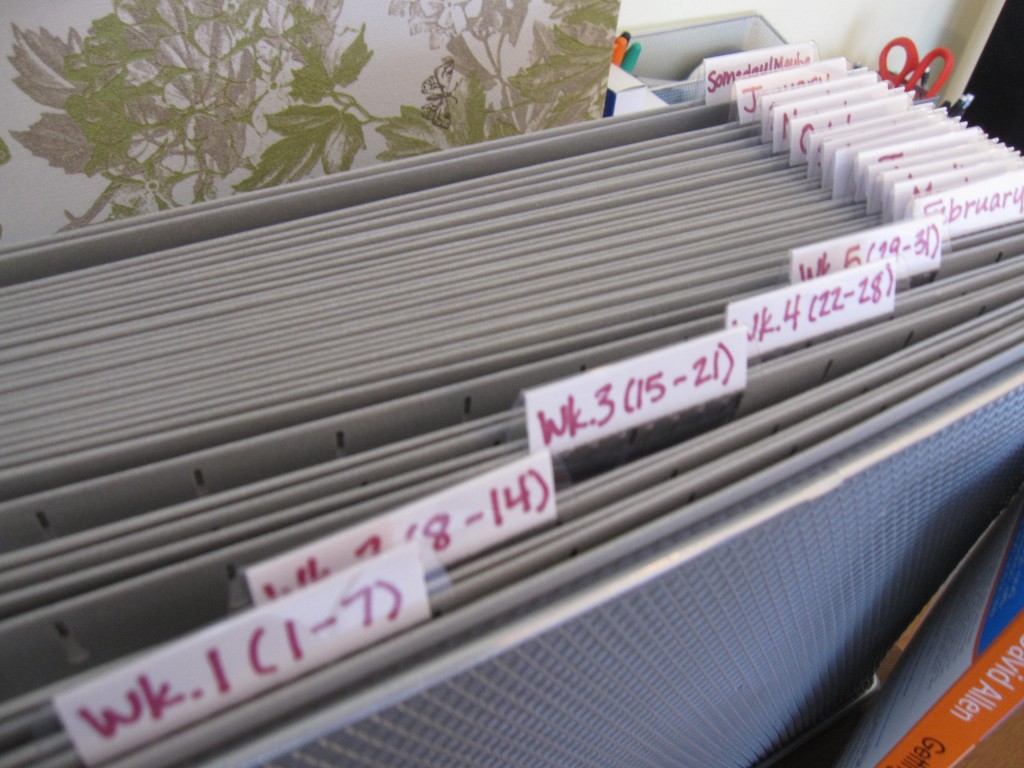
Friday Fave: Getting Things Done

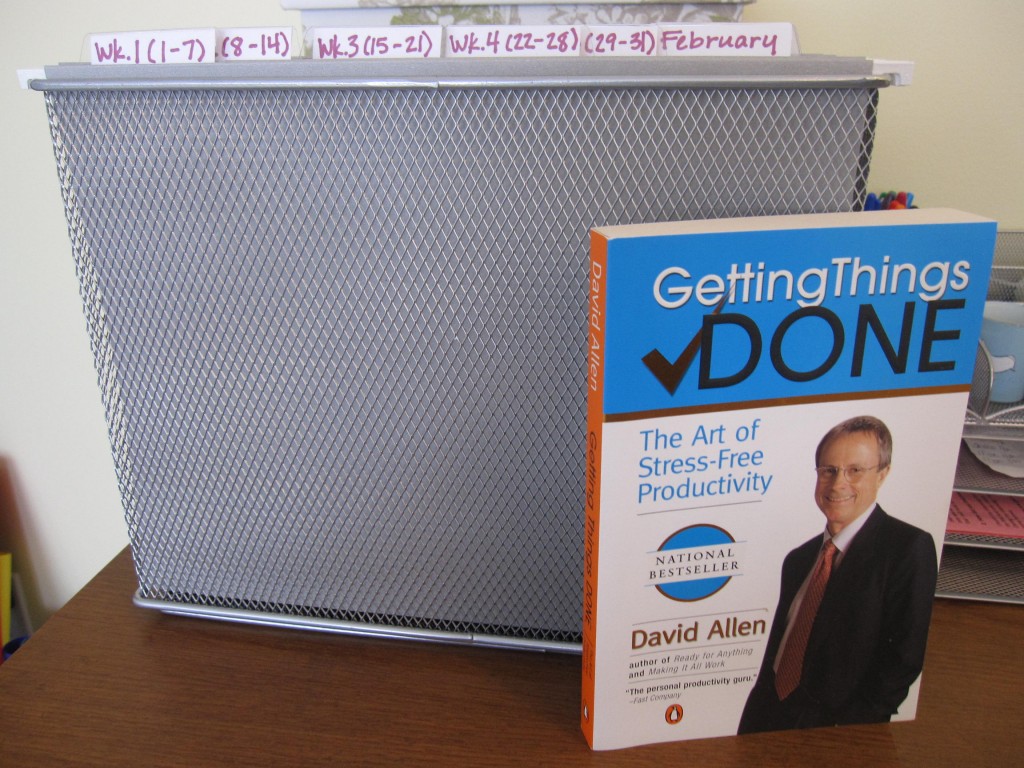
Getting Things Done by David Allen

This book was recommended to me by the lovely Music Therapy Maven at the perfect time in my life.  Last year around this time, I was just a little stressed (and by a little, I mean so much so that I wrote this blog post).  But I listened to the audiobook version of Getting Things Done, and immediately implemented the system.

My biggest problem before reading this book was carrying my to-do list around in my head and letting it cause anxiety day in and day out.  It was a total “duh” moment for me when I read the part about getting the tasks out of my mind and down on paper.  Not a huge list, as I was used to compiling on a weekly basis, but a single action step I could take towards completing a task or project.

That’s where the tickler file comes in.  A simple concept, really: file folders for each month of the year, plus one for each week of the current month.

Getting Things Done by David Allen

That phone call I needed to make this week?  I wrote it down on a sticky note and put it in this week’s folder at the beginning of the month so that it was waiting for me.  The conference I’m presenting at next September?  All of that info is in the August folder, so when it’s time to start thinking about it, I can pull it out and do so.  No longer do random papers, forms, and bills clutter my desk’s main inbox and cause me stress on a daily basis.

There’s one more folder in my tickler file, and that’s the “Someday/Maybe” folder.  What goes in there: ideas I don’t have time for right now, information that may become useful at some point, lead sheets for songs I find that I might want to adapt and use in the future, etc.  It’s my go-to place when I have some spare time and might be able to take action on any one of those items.

It’s so much easier to look at a project as a list of steps, rather than one big scary cloud hanging over my head.  Of course, I still experience stress, but nowhere near the levels at which I once did.  And anything that can lower my stress is effective, trust me!  That’s why I always recommend Getting Things Done to everyone.

What about you?  Have you read the book, or do you have another system for getting organized and keeping your to-dos from overwhelming you?

Turn the Beat Around

Turn the Beat Around

Why yes, I am referring to that old song made famous by Gloria Estefan in the 90s.  I used to love it way back in the day, especially trying to sing along with the crazy fast syllable-full verses.

While I was brainstorming new instrument songs last week, this one just popped into my head and refused to leave.  But it turned out to be a good thing, because I ended up tailoring the lyrics just enough to make it the perfect rhythm sticks song.

I predicted that when I played it with my Church Mice on Sunday, the parents would get a kick out of it…and I was right.  Most of them knew the song and were singing along with me right away.

Turn it up, turn it up, turn it up so loud!

Turn the beat around,
Love to hear the percussion.
Turn it upside down,
Love to hear the percussion.
Love to hear it.

Oh, you sure sound pretty,
Your rhythm keeps movin’ to the nitty gritty
When you hear the tap of the wood a-tappin’
Then you’ll know that rhythm carries all the action,
Woah, yeah!

Turn the beat around,
Love to hear the percussion.
Turn it upside down,
Love to hear the percussion.
Love to hear it.

Turn it up, turn it up, turn it up so loud!

Turn it down, turn it down, turn it down so soft…

Turn the beat around!

I had a lot of fun with this recording, in case you can’t tell by listening to it.  I’m thinking about tweaking the lyrics to make it a drumming activity for my students.  And that’s the best thing about this song — it could be used with or without any instrument, not just rhythm sticks.  Even keeping the original lyrics would work, because they’re all about music.

How would you use it?  Or maybe you wouldn’t at all.  It didn’t cross my mind as a good song for kids until just recently, but I’m sure glad it did!  Except for the part where it is permanently stuck in my head, that is ;)

Adapted “Rhythm of Love” Lyrics & Chords

Plain White T's Rhythm of Love

I covered this song in yesterday’s “Sunday Singalong” video, and have been getting requests for my version of it ever since.  What a compliment!  So for those of you who want to use it with your own students or just for fun, I’ve got you covered.

Click below for a free download of my adapted lyrics, plus the chords.  Please note that when I sing and play it, I capo the 2nd fret.

Lead Sheet Download: Rhythm of Love

One of my Twitter friends reminded me how great it would sound on the ukulele, so I’m going to play around with that next. Oh, and feel free to adapt the lyrics further if you’d like. I hope you have as much fun with this song as I do!

Sunday Singalong: The Rhythm Of Love

I heard this song for the first time as I was driving home from work a couple of weeks ago, and I was immediately hooked.  It was simple, beautiful, and happy…my three favorite ingredients when it comes to music.  I knew then and there that I just had to add it to my Sunday Singalong playlist.

My adapted version is less a love song about another person and more a love song about life.  I can’t wait to introduce it to my students next month — I envision creating all kinds of rhythms of our own using drums, shakers and whatever else I decide to throw into the mix.  Did you notice that my Rhythm Ring made another guest appearance in the video?  I can’t get enough of it!

Earlier in the week, I asked my Facebook and Twitter friends to guess which current, love-themed pop song I would be covering today.  Props to Kristen Bozard for nailing it, and an honorable mention to Jess Kaps for lots of awesome guesses.  Jess, you gave me some great ideas for future videos!  If the rest of you have additional suggestions, please leave them in the comments…because I am a total sucker for overplayed radio hits.