Sunday Singalong: Picture Schedule Song

This week’s video is super short, but the picture schedule song is an important part of every music therapy session (and certain classes) I lead. It sets the tone and lets my student(s) know what to expect, as well as what my expectations for them are.

The post I refer to in the video is a tutorial on creating schedule cards.  Way back when I first started making them (including most of the cards you saw above) I used Boardmaker, but now I prefer finding my own pictures. It’s just more fun that way :)

Now go out and enjoy the rest of your holiday weekend, and I’ll do the same.  Happy Labor Day!  See you back here soon.

The Green Grass Grew All Around

Green Grass Grows All Around

Admittedly, I didn’t know this song when I first started my career as a music therapist.  I quickly learned it, though, after realizing that I might very well be the only person on earth (or at least at The Hope Institute) that didn’t.  Because my students requested it so often, I decided to turn a “fun” song into a “fun-ctional” one.

There are three general goal areas I can target this song.  They are 1) Color Identification; 2) Memory; and 3) Working as a Group (which falls under the umbrella of social skills).  I’ll explain how I address each goal below.

Phew! That is a LOT of words. I’m impressed that I can sing the entire thing from memory, let alone my students :) Here’s a way to make it a little easier while also targeting the goals that I listed above.

Take a piece of light blue posterboard or foamboard. Cover the width of the bottom 6 inches or so with green construction paper, and then you’ve got your grass on the ground and sky above. Color a hole in the middle of the grass section (I just use a brown marker for this). Then comes the fun part: create each item listed in the song — a tree, limb, branch, twig, nest, egg, and bird — using cardstock, markers, construction paper, and whatever else you want. In fact, this makes for a great art project for your students. You may want to laminate the items so that they hold up. Attach a small piece of velcro to the back of each, and the other side of velcro to the posterboard so that they can be easily attached to the correct spot.

Let each student take his or her turn placing an item on the posterboard and identifying the color of that item. With the visual aide, it’s much easier to remember what logically comes next in the song (for you and the students!). At the end of the song, your students have worked as a group to create an entire scene.

If I’m just singing this song for fun with a group and don’t have the resources for the full activity, I’ll pass out green egg shakers and ask the children to shake them only when the “green grass” is mentioned. Talk about impulse control!

Singable Story: Miss Mary Mack

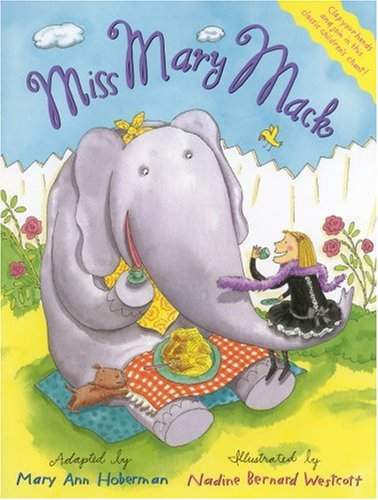
Miss Mary Mack - Children's Book

Hand clapping games were all the rage on the playground when I was growing up.  “Miss Mary Mack” was one of the first I ever learned, so when I came across this book on Amazon, I couldn’t pass it up.  I’m glad I didn’t, because Miss Mary Mack ranks right up there with Down by the Station, Going on a Bear Hunt, and Goodnight Sweet Butterflies as one of my favorite singable stories.

There are a few ingredients that make for a good children’s book in an educational setting.  Repetition, alliteration, and rhyme are key, and Miss Mary Mack is chock full of all three.  I found a fun little groove in Garageband to serve as accompaniment for the melody:

I know this isn’t the traditional “Miss Mary Mack” tune, but I found it to be a little more melodic (especially important since it’s sung over and over again) than the hand clapping version. No matter how you sing it, this is a great story for kids whether you’re targeting specific learning objectives or just reading it for fun.

Back to School!

It’s that time of year: many students are returning to school, and so am I. After a nice long summer break, I’m heading back to The Hope Institute for my 4th (!) school year as a music therapist. It’s going to be an exciting one — I’ll be supervising my first-ever music therapy intern. Up until now, my department has been a one-woman show, so it will be nice to finally have some company!

In honor of the new academic year, I’d like to share some school-related songs. These can all be downloaded from my studio album, Time to Sing Hello, which debuted earlier this summer.  The first is all about getting there…on the bus, of course!

My favorite thing about going back to school (both when I was a student and now as an employee) is seeing old friends and making new ones. Socializing is a goal area that I address often with my students, so this song comes in handy:

I’m on a tight schedule during the school day! I have classes to see, meetings to attend, and planning to do, which means I need to keep a close eye on the clock. Many kids are learning how to read the clock for themselves, which is exactly why I wrote the next tune:

There’s one thing that must be done before it’s time to say goodbye and head home for the day, and that is cleaning up. Almost everyone knows the old “Clean up, clean up, everybody, everywhere” song, but I got tired of that one and came up with my own:

Check out the rest of my school-friendly tunes here. For those of you who are getting back into the swing of the school year, good luck!  It can be a stressful time, but it can also be lots of fun.

A Drum Song for Seth

Paddle Drum

Seth loved drums. It didn’t matter what kind – if he could use a mallet or his hand to make a big sound, he was a happy camper.  What Seth didn’t love was following his music therapy schedule and completing his work.  On the rare occasion that he did finish a task, he was rewarded with the chance to play a drum.  His face would light up and he would say “Boom, boom!” as he played, which is what gave me the idea for a song that would serve two purposes.

All this time, I had been using the drum only as a reward.  Why hadn’t I thought to incorporate the drum into Seth’s goal-based interventions?  (The answer to that question: because I was an intern, and I still had a lot to learn.)  One of Seth’s IEP goals was to count to 20, and I was determined for him to achieve it with the help of the drum.  At that point in my young career, I hadn’t written many songs of my own.  But this one worked, so I still use it today.

Boom, boom!
We can count to twenty.
Let’s start with number one.
Boom, boom!
We can count to twenty,
While we play our drum!

1, 2, 3, 4,
5, 6, 7, 8,
9, 10, 11, 12,
13, 14, 15, 16,
17, 18, 19, 20!

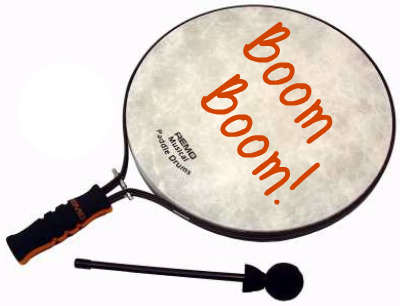
I used a paddle drum just like the one pictured above when I sang this song with Seth.  He held the mallet, and I held the drum up only when it was his turn to play (during the “Boom, boom!” lines and as he counted).  Not only did Seth achieve his goal, but he wanted to count even higher so that he had more chances to play the drum!

This song took the work out of counting, just as music so often does for tasks that might otherwise be mundane or frustrating for children.  The key is figuring out the motivating factor.  I may have helped teach Seth to count to 20, but I owe Seth big time for teaching me this important lesson.

Sunday Singalong: Shakin’ It Up

Happy weekend! After a short hiatus, I’m back with a brand new “Sunday Singalong” video. This time I’m shakin’ it up with a song I wrote specifically for fruit shakers, which I added to my instrument collection last summer.  I’ve posted this song before, so you can listen to the entire song and get the sheet music by following that link.

The “Shaky Fruit” song is very straightforward, and the objectives are clear: listen (or use visual cues) for your turn to shake your fruit, and only shake your fruit during your turn.  But the second version I presented goes just a little deeper.

The key moment comes when I ask the group, “Where is (child’s name)?” and the child replies, “Here I am!”.  The primary objective was for the child to respond verbally to his or her own name; playing the instrument is simply a reward for doing so.

My friend and colleague, Lea Keating, explains the importance of a child being able to do just that in her latest blog post.  It took a very scary situation to remind her of this, as she details in her post, but it serves as a lesson for every parent, therapist, and educator out there.  You can read it here.